Article 10 Explaining Admissibility and Governance in a Regulatory Sandbox
Altomi Journal — Article 10
Explaining Admissibility and Governance in a Regulatory Sandbox
Shaun Flynn · April 2026 · Altomi Pty Ltd
Simulation, Not Live Operations
The following recounts a deliberate sandbox exercise designed to test how operational governance behaves when admissibility is not independently established — and what that reveals about authority, execution, and verification.
This was not a live production run. The system is cloud-based and fully operational, but all activity described below was configured and executed by the owner-operator as a controlled simulation.
The objective was to explore a question raised during an external exchange:
Can a system remain internally coherent even when admissibility was never established as an independent condition?
Structural Frame of the Test
The exercise was configured to reflect the following conditions:
Decision executed under valid constraints — inputs processed according to defined rules
Validation passes — all checks completed successfully
Process is consistent — no internal contradictions or execution errors
Structural condition:
Admissibility not established independently
Authority derived from the execution system itself
No alternative formation or external authority introduced
Question tested:
Can the system detect the absence of admissibility as a condition?
Implementation in Multiverse
A test batch was created:
Batch No: TRUE OR FALSE
Product: BS DETECTOR
Recipe: TRUE OR FALSE BS DETECTOR
GMP Checklist: IS THE INPUT TRUE OR FALSE (7 checks)
Inline QA Checklist: BS DETECTOR (5 tasks, each representing a different measurement type)
Area: REGULATOR TEST THEORY
The five inline QA tasks deliberately covered different evaluation models:
Binary pass/fail
Numeric range validation
Multi-classification (CCP, QCP, RCP)
Completion confirmation
Multi-condition confirmation
Each task was:
individually executed
timestamped
immutably recorded
All within a single governance structure.
Observations from the Simulation
System Coherence
The system executed all tasks without error.
Validation passed.
All records were captured and preserved immutably.
Nothing in the execution layer signalled a problem.
Role Separation Limitation (Explicit)
The system did not detect the absence of independent admissibility.
This is expected in the current configuration:
The system is single-user
The same individual defines, executes, verifies, and signs off
Authority is not structurally separated
An auditor reviewing this scenario in a live environment would immediately identify this:
Multiple critical actions attributed to the same individual
No independent authority at key control points
This is not a failure of the system.
It is the current implementation state.
Architectural Direction
The architecture is designed to support enforced role separation.
When implemented:
Definition of admissibility (e.g. recipe, GMP conditions)
Execution of process
QA verification and clearance
will be structurally separated through permissions.
At that point:
A single actor cannot control all admissibility boundaries
Independence becomes enforced, not assumed
Domain-Agnostic Capability
The simulation confirms:
Multiple evaluation models can operate in parallel
External inputs (including analytical or advisory content) can be captured
Governance structure remains consistent regardless of scenario
This establishes the system as a true regulatory sandbox:
Not tied to one domain
Not limited to one interpretation of “process”
Capable of testing governance itself
Implications for Governance
This exercise demonstrates three grounded points:
Coherence is not proof of admissibility
A system can run correctly, validate correctly, and still lack independent authority.Execution cannot detect what is not structurally represented
If admissibility is not enforced through independent roles or conditions,
the system has no basis to reject execution.Governance must be designed into structure, not inferred from behaviour
Logs, validation, and consistency confirm execution —
they do not establish legitimacy.Boundary Clarification
This exercise does not resolve admissibility as a governing condition.
It demonstrates the condition under which admissibility, when not independently established, remains non-operative at execution.The system continues to execute coherently, validate successfully, and preserve traceability — not because admissibility is satisfied, but because its absence is not structurally represented as a condition capable of interrupting binding.
Key Takeaways
The Multiverse environment can simulate governance scenarios without impacting live operations
Independent admissibility is not yet enforced in a single-user configuration
The absence of that independence is visible to an auditor, not to the execution system
Role-based separation is the next required implementation step
The architecture is capable of supporting that separation when deployed in multi-user environments
This is a proof of principle:
The system can execute, record, and preserve any scenario.
Whether that scenario is governed depends on how authority is structured within it.
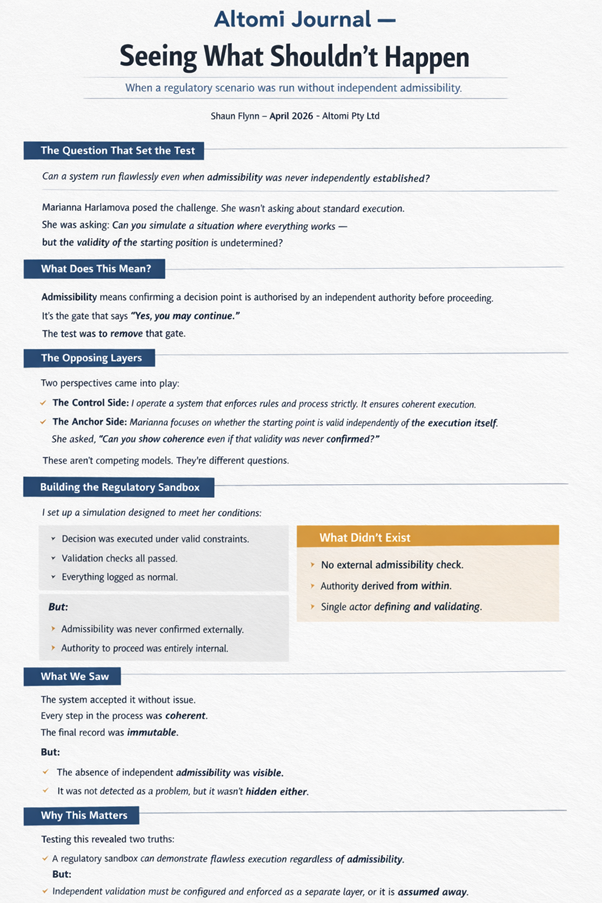
Concurrent structures within a single batch: operational output and regulatory sandbox running in parallel under the same governance model, with independent evaluation paths. Sandbox scenario informed by external exchange on admissibility and execution boundaries.